PROLOGUE
In June 2000, Microsoft ($MSFT) acquired a small Chicago-based studio called Bungie for somewhere in the region of $40 million. It was, by any reasonable measure, a modest transaction. Bungie had built a loyal following on Macintosh systems through its Marathon and Myth franchises, but they were not yet a household name. What Microsoft was really buying was a game called Halo, then in development and quietly extraordinary, which they promptly repositioned as the launch title for their first Xbox console. The rest is cultural history. Halo became the Master Chief, the Master Chief became Xbox, and Xbox became a credible challenger to Sony's PlayStation dominance for the first time. Forty million dollars had purchased an identity.
Seven years later, Bungie negotiated their independence. Microsoft retained the Halo IP — the asset they had originally paid for — and Bungie left to build something new. In 2010, they signed a ten-year publishing deal with Activision and began work on Destiny, a live-service shooter designed for a connected world that the original Xbox could barely have imagined. They retained ownership of the IP throughout. When that Activision partnership ended in 2019, Bungie walked away with Destiny in hand, self-publishing and fully independent for the first time in nearly two decades.
Then, in January 2022, Sony acquired them for $3.6 billion.
The studio that built Microsoft's identity now sits inside PlayStation. Halo, the franchise Bungie created and Microsoft kept, will soon release on Sony's systems. And the $3.6 billion Sony paid represents, depending on how you account for inflation, somewhere between 54 and 89 times what Microsoft paid at the turn of the millennium. That expansion in valuation is not simply a story about one studio's journey. It is a map of how the entire economics of the gaming industry shifted beneath everyone's feet, and why the biggest companies in the world spent the better part of two decades trying to work out what, exactly, they should be buying, and why.
ACT ONE: THE REFINERY BUSINESS
The console wars of the early 2000s were, on the surface, a hardware story. Sony's PlayStation 2 dominated with an install base that would eventually reach 155 million units. Microsoft had entered the market in 2001 with the original Xbox, a credible challenger, better specified, less commercially successful. Nintendo occupied its own orbit. The battle for living room supremacy generated enormous press coverage and genuine consumer passion, but for anyone watching the economics rather than the scoreboard, the more interesting story was happening one level down the corporate chain.
Independent studios in this period occupied a structurally precarious position that is easy to underestimate in retrospect. Development costs were rising sharply. A PlayStation-era title could be produced for somewhere between $800,000 and $1.7 million. By the PS2 generation that range had expanded to $5-10 million. The arrival of the Xbox 360 in 2005 and PlayStation 3 in 2006, with their demands for high-definition assets, larger teams, and longer production cycles, pushed typical AAA budgets to $15-20 million, with prestige titles running considerably higher. Halo 3, released in 2007, carried a reported development cost of $30 million and a marketing budget of $40 million on top. An EA whitepaper from DICE Europe, presented during this transition period, documented the consequence with unusual clarity: the number of studios capable of producing AAA-level content contracted from approximately 125 to around 25, while the staffing required per title increased roughly fourfold.
This compression created the conditions for consolidation. An independent studio with genuine creative talent but insufficient capital to survive a two or three year development cycle on a next-generation title had limited options. It could seek a publishing deal, retaining independence but ceding commercial control and accepting ongoing royalty arrangements that eroded the economics of success. It could seek external investment, increasingly available as institutional capital began to recognise gaming IP as an asset class, but carrying its own governance costs. Or it could sell. For the publishers, the calculus was straightforward. Owning the studio meant owning the IP. Owning the IP meant that incremental revenues from sequels, expansions and licensing flowed more directly to operating income, unencumbered by royalty obligations to an external developer. Activision's own annual report made this explicit: following the acquisition of Infinity Ward and the success of the original Call of Duty, the cost of sales attributable to intellectual property licences fell from 7% to 5% of publishing revenues in a single year. That margin improvement, modest in percentage terms, was significant in absolute dollars at the revenue scales these companies were operating, and it compounded with every subsequent title in the franchise.
The publisher tier was therefore not acquiring studios out of creative enthusiasm. It was solving a cost structure problem while simultaneously building the IP portfolios that would define their long-term competitive position. The studios were the raw material. The publishers were building refineries.
Three Models, One Decade
The consolidation that followed was not uniform. Three distinct acquisition philosophies emerged among the major publishers through the mid-2000s to early 2010s, each reflecting different assumptions about where value resided and how it could be sustained.
Electronic Arts ($EA) pursued genre empire building: aggressive, capital-intensive, and in several cases self-defeating. The strategic logic was coherent: dominate enough genres simultaneously that no competitor could offer a comparable breadth of content to retail partners or consumers. Sports was already an owned category through EA Sports. The acquisition of DICE in October 2006, completed for SEK 175.5 million, approximately $23.9 million at the time, secured the Battlefield franchise and gave EA a credible presence in the military shooter genre then being defined by Call of Duty. The price was modest by any reasonable measure, reflecting both DICE's relatively small size as a Stockholm-listed developer and the fact that EA had been a partial owner since 2004, reducing the informational asymmetry typical of studio acquisitions.
The more significant transaction came in October 2007, when EA acquired VG Holding Corp., the parent company of both BioWare and Pandemic Studios, from private equity firm Elevation Partners for approximately $775 million, structured as $620 million in cash to stockholders, up to $155 million in equity to employees subject to vesting criteria, and a $35 million bridge loan to fund the transition. The deal was notable for several reasons beyond its size. Elevation Partners' involvement signalled that institutional capital had arrived in gaming. Studios were no longer being valued as development shops. They were being valued as IP portfolios, with franchise revenues capitalisable and acquirable. The $775 million price for two studios employing 800 people implied a per-head valuation that would have been unimaginable a decade earlier.
It also bought two very different businesses in a single transaction. BioWare, based in Edmonton, was a prestige RPG studio whose catalogue — Baldur's Gate, Knights of the Old Republic, Neverwinter Nights — represented some of the most critically acclaimed and commercially durable franchises in PC gaming. Pandemic, based in Los Angeles, was a capable multiplatform developer with a track record in action games and licensed properties, including the Star Wars: Battlefront series. EA projected that games from the two studios would contribute nearly $300 million in combined revenues in 2009 and 2010. That projection, and what became of it, tells the story of EA's acquisition model more honestly than any press release.
BioWare survived the acquisition, producing Mass Effect and Dragon Age as new franchises under EA ownership, though its creative reputation would erode progressively over the following decade as production pressures and franchise obligations accumulated. Pandemic did not survive at all. By November 2009, less than two years after the acquisition closed, EA had shut the studio entirely, laying off 228 employees and absorbing a small IP team into EA Los Angeles. The official rationale cited economic conditions and the need to streamline operations. The former Pandemic president Josh Resnick was more candid in a subsequent interview, describing a studio stretching itself across multiple large open-world projects simultaneously, each expensive and technically complex, in an environment where EA needed efficiency rather than ambition. The $775 million acquisition had purchased, in Pandemic's case, roughly eighteen months of continued operation.
This pattern, acquire, absorb, close, was not new for EA. Bullfrog Productions, Westwood Studios, Origin Systems, Maxis had all preceded Pandemic through variants of the same cycle. The structural reason was consistent across cases: EA's publishing model required studios to operate as production units within a coordinated release schedule, and creative cultures built around founder-led autonomy rarely survived that transition intact. The acquirer's model treated human capital as fungible in a business where it was anything but.
Activision's approach was more surgical and, commercially at least, more durable. Where EA was assembling a genre portfolio, Activision was solving a specific operational problem: how do you sustain annual releases of a AAA franchise without burning out the studio responsible for it?
The solution they arrived at, through acquisition rather than design, though it became explicit strategy, was the rotating studio model. Treyarch had been acquired on October 1, 2001, a straightforward purchase of a console developer with a history in action and sports titles. Infinity Ward's acquisition was more structurally interesting. Activision acquired an initial 30% stake in May 2002, providing the capital to fund development of the first Call of Duty while retaining an option on the remaining 70%. When Call of Duty released in October 2003 and immediately ranked as the top-selling PC title in North America, Activision exercised that option, acquiring the remaining 70% for approximately $3.5 million in cash. Total goodwill recorded on the transaction was $3.8 million, assigned entirely to assembled workforce, consistent with how Activision accounted for all its studio acquisitions of this period.
The arithmetic of what followed is striking. Activision paid somewhere in the region of $5 million in total consideration across both tranches for a studio whose franchise would go on to generate billions in revenues. But the more instructive detail is not the purchase price. It is the structure of the option. Activision effectively funded the creation of Call of Duty while contractually securing the right to own it outright once its commercial viability was established. The risk of development failure sat with Infinity Ward. The upside of commercial success sat with Activision's option. That is not simply a good deal. It is a specific and replicable investment structure, one that subsequent acquirers in the space would have done well to study.
With Infinity Ward and Treyarch each on roughly three-year development cycles, Activision could sustain annual Call of Duty releases by alternating between studios: Infinity Ward building the technology and setting the template, Treyarch using the updated engine to produce the intervening entry. Sledgehammer Games, founded by former Visceral Games developers and acquired by Activision in 2009, would eventually join the rotation as a third studio, extending the model's capacity. This was franchise management as manufacturing process. For the better part of a decade it worked with extraordinary commercial consistency, producing the best-selling game in North America for eleven consecutive years between 2009 and 2019.
The third model was quieter and, in the long run, arguably the most financially instructive. Take-Two Interactive ($TTWO) pursued a philosophy almost inverse to EA's: minimal interference in studio operations, genuine creative autonomy, and a willingness to accept irregular release cadences in exchange for output of exceptional quality and commercial durability.
The foundation of this approach was assembled in two transactions separated by approximately a year. In March 1998, Take-Two acquired BMG Interactive's publishing and distribution business from Bertelsmann in a stock-for-assets deal: 1.85 million newly issued Series A Convertible Preferred shares, carrying a liquidation preference of $6.875 per share, implying a notional deal value of approximately $12.7 million. No cash changed hands. The asset package included European distribution infrastructure across the UK, France and Germany, a pipeline of twelve titles across PlayStation, Nintendo 64 and PC, and, almost incidentally among the line items, worldwide publishing and distribution rights to an upcoming PC and PlayStation title called Grand Theft Auto.
The employment term sheet for Sam Houser, executed as a condition of closing, suggests Take-Two's lawyers understood that the human asset was at least as important as the IP. GTA without Houser's creative direction was a different proposition. In September 1999, Take-Two completed the acquisition of DMA Design Holdings, the studio that had created Grand Theft Auto, from Infogrames Entertainment SA for the nominal consideration of £1, while assuming approximately $11.9 million of indebtedness and repaying a £3.25 million intercompany loan. The real economic outlay across both transactions, assembling the IP and the studio simultaneously, was somewhere in the region of $25-30 million, paid largely in stock rather than cash.
GTA III, released in October 2001, generated over $800 million in revenue. GTA V, released in 2013 and still generating material revenues through ongoing online operations, has crossed $8 billion in lifetime sales across all platforms. The combined acquisition cost of the IP and the studio that would build it into one of entertainment's most valuable franchises was less than the marketing budget of a single mid-tier Xbox 360 title.
What Take-Two understood, and what EA's parallel history suggests it did not, was that the value in a creative studio is not extractable on a production line schedule. Rockstar's games released irregularly, took as long as they took, and cost what they cost. Take-Two absorbed that operational reality rather than attempting to rationalise it away. The financial model that resulted — long gaps between releases, enormous commercial events when they arrived, sustained revenue through online components in the intervening periods — is now widely recognised as one of the most durable in the industry. At the time, it looked like tolerance for chaos.
| Acquirer | Target | Year | Consideration | Strategic Rationale |
|---|---|---|---|---|
| Take-Two | BMG Interactive | 1998 | $12.7M | GTA IP + European distribution |
| Take-Two | DMA Design | 1999 | $17M | GTA studio acquisition |
| Activision | Treyarch | 2001 | Undisclosed | CoD rotation capacity |
| Activision | Infinity Ward | 2002–03 | $5M | CoD IP ownership |
| EA | DICE | 2006 | $23.9M | Battlefield franchise |
| EA | BioWare/Pandemic | 2007 | $775M | Genre portfolio expansion |
| Activision | King | 2016 | $5.9B | Mobile diversification |
Ubisoft: The Counter-Model
Ubisoft ($UBI) occupied a different position in this landscape entirely. Where EA, Activision and Take-Two were building through purchase, Ubisoft was building through internal development — a strategy that produced the most creatively productive decade in the company's history and, ultimately, the structural fragility that would define its second.
The Guillemot family had founded Ubisoft in Brittany in 1986 and by the early 2000s had assembled a network of internally established studios — Ubisoft Montreal, Ubisoft Paris, Ubisoft Montpellier — that became the engine behind one of the most prolific franchise rosters in the industry. Prince of Persia, Splinter Cell, Ghost Recon, Rainbow Six, Far Cry, and eventually Assassin's Creed were all products of this model. Rather than paying acquisition premiums for proven studios, Ubisoft invested in geographic labour arbitrage, establishing development operations in Montreal, Quebec City, Singapore, Kyiv and Bucharest, where talent was abundant and costs materially lower. The model generated extraordinary IP breadth at comparatively modest cost per title.
The vulnerability only became visible when Ubisoft attempted to do to Assassin's Creed what Activision had done to Call of Duty. Annual releases became the standard from 2009 onwards; by 2014 there were two entries in a single year. Assassin's Creed Unity shipped in a state of serious technical disrepair, a direct consequence of the production pressure the annual cadence imposed, and the reputational damage was immediate and lasting.
The M&A dimension of Ubisoft's story is less about what they acquired and more about what others attempted to acquire from them. EA made a hostile approach in 2004. Vivendi began accumulating shares in 2015, reaching approximately 25% by 2017 and triggering a prolonged corporate defence that consumed significant management attention at precisely the moment when Ubisoft's creative output needed careful stewardship. They succeeded in maintaining independence — Vivendi sold its stake in 2019 — but the episode illustrated a structural vulnerability organic IP development alone could not resolve: a publisher whose stock price is hostage to a small number of ageing franchises is permanently exposed to opportunistic accumulation. The conditions that would eventually necessitate the Tencent investment — franchise fatigue, a narrowing portfolio, and the perpetual threat of hostile capital — were all consequences of a model that built creative breadth without building the financial resilience to sustain it.
What Consolidation Produced
By the early 2010s the publisher tier had stratified decisively. A small number of companies controlled the majority of commercially significant IP and the development infrastructure required to produce it at scale. The investment thesis was legible: diversified portfolios, recurring franchise revenue, rising development costs that protected incumbents by raising barriers to entry.
What that analysis could not account for was the degree to which the stability was contingent rather than permanent. Digital distribution was dissolving the retail model that had made publishers indispensable. Mobile was building an entirely parallel gaming economy outside the franchise manufacturing logic entirely. And subscription economics were beginning to reshape what platform holders needed from content ownership in ways that the publisher tier had not yet had to reckon with.
Activision's acquisition of King Digital Entertainment for $5.9 billion in February 2016 was the first unambiguous signal. The largest pure-play publisher in the world had concluded that the world it had built was insufficient on its own. The platform holders were about to reach the same conclusion, by more dramatic means.
ACT TWO: THE PLATFORM RECONSOLIDATION
Two forces had been accumulating pressure beneath the publisher tier's apparent stability, and by the mid-2010s both were impossible to ignore. The first was digital distribution, not as a novelty, which it had been through the mid-2000s, but as the primary channel through which the majority of gaming revenue flowed. By the early 2010s the transition was well underway; by the late 2010s it was essentially complete for the major platforms. The second force was the subscription model, which digital distribution made possible and which, once introduced at scale, changed the fundamental question of what a platform holder was actually selling.
These two forces did not affect all participants equally. For the publisher tier, digital distribution was broadly beneficial. It eliminated physical returns, reduced distribution costs, and created a direct relationship with consumers that retail had always intermediated. But for the platform holders, the implications were more disruptive. If consumers no longer needed to visit a retailer to access games, the console itself became less of a gateway and more of a credential, a device that authenticated membership in an ecosystem. And once the ecosystem logic took hold, the question of what content lived inside that ecosystem, and who owned it, became far more strategically consequential than it had been in the retail era.
Microsoft arrived at this realisation from a position of acute competitive disadvantage. The Xbox One launch in May 2013 had been one of the most damaging product introductions in the history of consumer electronics. The always-online requirement, the mandatory Kinect camera, the used games restrictions, the price premium relative to PlayStation 4. Sony's E3 response that year, a 33-second video demonstrating how to share a PlayStation 4 game by simply handing it to another person, became one of the most effective pieces of competitive marketing the industry had ever produced. By the end of the generation PlayStation 4 had sold approximately 117 million units against Xbox One's estimated 58 million, a gap that represented not just hardware revenue foregone but an entire generation of consumers who had built their gaming identity, their friend networks, and their digital libraries inside the PlayStation ecosystem.
Phil Spencer's appointment as head of Xbox in March 2014 did not immediately reverse the trajectory, but it changed the strategic framing. The fuller arc of Spencer's tenure, and the recurring misalignment between Xbox's strategic ambitions and its player base, is examined in detail in a companion piece. What matters here is the M&A logic that followed his appointment. Game Pass, launched in June 2017, provided a new competitive frame entirely. Rather than competing on hardware units sold, Microsoft would compete on subscribers retained. Rather than measuring success by exclusive titles that moved consoles, they would measure it by content breadth that justified a monthly fee. It was a genuine strategic pivot, and it created an immediate and urgent problem. A subscription library needs content. Microsoft's first-party output at that point was historically thin. Halo, Forza, Gears of War, a franchise roster that against the depth Sony had assembled through its studio relationships was barely sufficient to sustain a subscription proposition.
The studio acquisition wave that followed was the solution to that content problem. At E3 2018, Spencer announced the addition of five studios to Xbox Game Studios simultaneously: Ninja Theory, Playground Games, Undead Labs, Compulsion Games, and the creation of a new internal studio called The Initiative. Obsidian Entertainment and inXile Entertainment followed later that year. The announcement was framed publicly as a commitment to creative diversity and new IP. That framing was not false, but it was incomplete.
The studios acquired in this wave shared a profile that is analytically revealing. Ninja Theory had made Hellblade: Senua's Sacrifice, a critically admired independent production with a modest commercial footprint, acquired for approximately $117 million according to documents that emerged through the FTC litigation over the later Activision deal. Obsidian had made Fallout: New Vegas and Pillars of Eternity, cherished by core RPG audiences, commercially solid, not system-sellers. inXile was a small studio with a loyal following in the Wasteland RPG series. Compulsion had made We Happy Few, a stylistically distinctive but commercially modest title. Playground had made Forza Horizon, the genuine exception, a franchise with real commercial weight and a demonstrable track record of moving hardware.
None of these, with the partial exception of Playground, were acquisitions you made if your primary objective was producing the next system-selling exclusive. They were acquisitions you made if your primary objective was populating a subscription catalogue with enough genre variety that a monthly fee felt justified to a broad audience. Game Pass's logic did not require any individual title to be a blockbuster. It required the library to be wide enough and deep enough that subscribers found sufficient value to remain. The evidence that the 2018 and 2019 acquisitions produced transformative exclusive IP is thin. Obsidian's The Outer Worlds was well received but not a phenomenon. Ninja Theory's Hellblade II arrived in 2024 to critical acclaim and muted commercial impact. The Initiative, the internally created studio whose sole purpose was to produce prestige AAA content and which recruited veterans from Naughty Dog, Santa Monica Studio, BioWare and Rockstar, spent seven years in operation before its debut project, a reboot of the Perfect Dark franchise, was cancelled in July 2025 and the studio closed. Seven years. No shipped product.
The 2018 acquisition wave was, in retrospect, a subscription catalogue strategy wearing the clothes of a creative renewal. The platform was buying density, not firepower. Whether that represented strategic vision or an accommodation of competitive reality is a question the Activision acquisition would force into the open.
The Escalation: ZeniMax
The 2018 and 2019 studio acquisitions were, by the standards of what followed, modest transactions. The aggregate consideration for the entire wave was likely below $500 million. What came next was of a different order entirely.
In September 2020, Microsoft announced the acquisition of ZeniMax Media, parent company of Bethesda Softworks, id Software, Arkane Studios, MachineGames, Tango Gameworks and others, for $7.5 billion in cash, confirmed in Microsoft's own SEC Form 8-K. It was the largest acquisition in gaming history at that point, and it represented a fundamental shift in Microsoft's acquisition logic. The 2018 studios had been bought to populate Game Pass with variety. ZeniMax was bought to populate Game Pass with franchises: The Elder Scrolls, Fallout, Doom, Wolfenstein, Dishonored, properties that carried genuine cultural weight and the kind of brand recognition that could justify a subscription to someone who had never previously considered one.
The EU approved the transaction without conditions in 2021, concluding it raised no meaningful competition concerns, a judgment that would be tested severely by what Microsoft announced fifteen months later.
The ZeniMax deal also immediately sharpened Sony's strategic exposure. Starfield, Bethesda's long-anticipated open-world RPG, would no longer come to PlayStation. The Elder Scrolls VI, whenever it arrived, would be an Xbox and PC exclusive. Sony had watched the 2018 studio acquisitions without obvious alarm. The studios involved were not producing content Sony's audience demonstrably wanted. ZeniMax was different. These were franchises with deep PlayStation histories and audiences that Sony could no longer guarantee access to.
Nintendo: A Different Calculation
Before turning to Sony's response, the Nintendo ($NTDOY) position in this period is worth briefly establishing, because its absence from the acquisition arms race is itself analytically instructive.
Nintendo entered this period navigating the aftermath of the Wii U, a commercial failure that had produced genuine existential questions about the company's hardware future. The Switch, launched in March 2017, resolved those questions decisively. A hybrid handheld and home console concept that generated one of the most commercially successful hardware launches in gaming history, eventually selling over 140 million units. The strategic preoccupation that defined Nintendo through this period was hardware innovation and the cultivation of their first-party software pipeline, not content library expansion through acquisition. They had no subscription ambitions comparable to Game Pass, no platform vulnerability comparable to Xbox One's, and no competitive pressure that required them to outbid rivals for third-party studios.
Nintendo's acquisition activity in this period reflected that position. It was minimal, targeted, and consistent with their longstanding preference for securing creative relationships rather than consolidating ownership. The one significant external acquisition, Next Level Games in January 2021, was the formalisation of a development relationship that had existed for over fifteen years. Next Level had worked exclusively on Nintendo projects since 2009. The acquisition changed the contractual relationship without changing the operational one. That is a characteristically Nintendo transaction.
Case Study: The Pokémon Anomaly
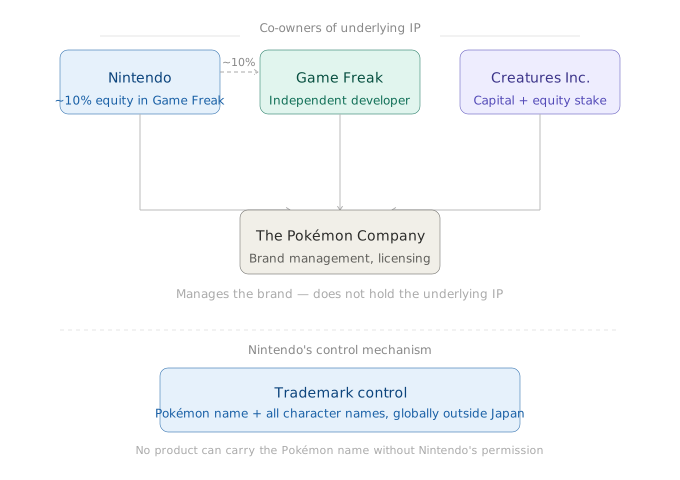
No examination of Nintendo's acquisition posture is complete without confronting its most consequential exception. Pokémon is not owned by Nintendo. It is co-owned, in proportions never fully disclosed, by three companies: Nintendo, Game Freak, and Creatures Inc. The Pokémon Company, established in 1998, manages the brand and licensing but does not hold the underlying IP. Nintendo, however, holds the trademark to the Pokémon name and all character names globally outside Japan — including Pikachu — meaning no Pokémon product could carry its name without Nintendo's permission regardless of how the underlying ownership resolved.
The structure emerged from necessity. Game Freak was running out of cash before Pokémon Red and Green could be completed in the early 1990s. Creatures Inc. provided a capital infusion in exchange for an ownership stake. Nintendo provided platform and publishing infrastructure, eventually acquiring approximately a 10% equity stake in Game Freak, modest enough to confirm the relationship without converting it into formal control.
The result is the most commercially valuable media franchise in history — Pokémon has generated more revenue than Star Wars, Marvel, and Hello Kitty combined — sitting in a tripartite structure that Nintendo controls through trademark rather than majority equity. Game Freak remains genuinely independent, develops at its own pace, and cannot be directed by Nintendo the way an internal studio can. The recent mainline releases, Scarlet and Violet in particular, shipped in a state of conspicuous technical disrepair that Nintendo's own quality standards would not have permitted. The trademark control is formidable and preserves platform exclusivity. But the inability to govern the studio responsible for the franchise's primary product is a structural gap with no obvious parallel elsewhere in the industry at this scale — and one Nintendo has chosen, persistently, not to close.
Sony's Response
Sony's acquisition strategy through this period occupies a different register from Microsoft's entirely, less urgent, more deliberate, and in several cases more financially precise. Where Microsoft was building a content library from a position of competitive deficit, Sony was consolidating relationships that had already been proven and securing creative assets whose value had already been demonstrated before the acquisition closed.
The pattern that emerges across Sony's acquisitions of this period is structurally consistent, and it has a precedent examined earlier in this piece. Activision acquired an initial stake in Infinity Ward before the studio had produced anything, watched Call of Duty perform commercially, and only then exercised its option to acquire full ownership for $3.5 million. Sony's approach follows the same sequencing, applied at greater scale and over longer time horizons: cultivate the relationship, allow the creative output to establish commercial proof, then convert.
The Insomniac Games acquisition, completed in November 2019 for $229 million and confirmed in Sony's own SEC filing, is the purest expression of that logic. Spider-Man had released in September 2018 and sold over thirteen million copies in its first few months. Sony did not commission Spider-Man and then acquire the studio. They watched it perform, allowed the commercial evidence to accumulate for fourteen months, and then acquired a studio they had worked with as an exclusive partner for over two decades. The $229 million price reflected not a competitive auction but a negotiated conversion of a trusted relationship. Housemarque followed the same sequence: Returnal launched in April 2021, Sony acquired the studio two months later. Relationship first, commercial proof second, acquisition third.
Bluepoint was the most analytically distinctive purchase of the entire Sony wave. The studio's entire commercial history, spanning over a decade of exclusive partnership with Sony, consisted of high-fidelity remasters and remakes: Shadow of the Colossus, Demon's Souls, the Uncharted: The Nathan Drake Collection, the Metal Gear Solid HD Collection, produced at a quality level that matched or exceeded Sony's internal first-party output. The relationship predating the acquisition was itself the proof of concept. What Sony was acquiring was not a studio capable of generating new IP at scale, but a specialist instrument for extracting latent value from existing IP. In a development climate where original AAA titles required budgets of $100 million or more and development cycles of four to six years, the ability to produce a premium remaster in a shorter cycle at lower cost, while still commanding full retail price, was a genuinely valuable capability. Sony's back catalogue is among the deepest and most valuable in the industry. Bluepoint was a tool for monetising it efficiently, and the acquisition made Sony the owner of that tool rather than its client. Financial terms were not disclosed.
Nixxes, the Dutch studio acquired in July 2021, was even more targeted, a specialist PC porting house whose acquisition gave Sony direct control over the quality and timing of PlayStation game releases on PC, a platform Sony was beginning to treat as a meaningful revenue extension rather than an afterthought.
The cumulative picture of Sony's 2019 to 2021 acquisitions is of a platform holder that had refined, through practice, a specific and repeatable acquisition discipline: cultivate the relationship, allow the creative output to establish commercial proof, then convert. It is the most capital-efficient sequencing available in an industry where creative output is structurally unpredictable, and the financial results across these deals reflect that discipline. Insomniac at $229 million for a studio that would go on to produce the two best-selling PlayStation exclusives of the PS5 generation represents, in retrospect, one of the most underpriced acquisitions in the industry's history.
The discipline would be tested, and found wanting, in January 2022.
ACT THREE: THE RECKONING
January 2022 was not a single convergence. It was three.
On January 10, Take-Two Interactive announced its intention to acquire Zynga for $12.7 billion, a cash and stock transaction at $9.861 per share representing a 64% premium to Zynga's closing price, confirmed in Take-Two's SEC Form 8-K. Eight days later, Microsoft announced Activision Blizzard. Thirteen days after that, Sony announced Bungie. Three of the largest acquisitions in gaming history within the same three-week window, by three companies operating from fundamentally different strategic positions, each arriving at the same conclusion through different routes: that mobile scale, live service capability, and content volume were no longer optional at the top of the industry.
Take-Two's Zynga deal was the most financially legible of the three. Zynga's shares had fallen approximately 40% in the year before the announcement, depressed by post-pandemic normalisation in mobile engagement and investor concern about the company's pipeline. Take-Two was buying a good mobile asset in a depressed market. The strategic rationale was explicit in the filing: mobile gaming represented an estimated $136 billion in gross bookings in 2021, Take-Two's own mobile exposure was approximately 12% of net bookings at the time, and the transaction was projected to push that figure above 50% in fiscal year 2023. The Zynga acquisition was Take-Two completing, in a single transaction, the mobile diversification that Activision had pursued through King six years earlier. The premium paid was high. The timing, acquiring at five-year lows, was disciplined.
What the three-deal January also revealed, when disclosed during the FTC v. Microsoft trial in 2023, was that Microsoft had itself considered acquiring Zynga before Take-Two moved. The platform holder simultaneously attempting to purchase the largest gaming publisher in history had also been weighing a mobile-native casual games business. The scope of what the major platforms were prepared to acquire in this period was effectively unconstrained by category.
The Regulatory Collision
Every acquisition examined in this piece prior to Activision cleared regulatory review without meaningful friction. DICE passed. BioWare and Pandemic passed. ZeniMax passed in 2021, the EU concluding without conditions that it raised no competition concerns, a judgment that would be tested severely by what Microsoft announced fifteen months later. The assumption embedded in two decades of gaming M&A was that the industry, despite its scale, was not a domain of antitrust concern. The Activision deal ended that assumption permanently.
The FTC filed its challenge in December 2022, arguing the deal would suppress competition in console gaming, subscription services, and cloud streaming. The CMA in the United Kingdom initially blocked the transaction entirely in April 2023, before eventually approving a restructured version that excluded cloud streaming rights. The FTC's attempt to obtain a preliminary injunction failed in federal court in July 2023, with Judge Jacqueline Scott Corley finding the agency had not demonstrated the deal would substantially harm competition. Microsoft's key concession throughout the regulatory process was a binding ten-year commitment to keep Call of Duty available on PlayStation, a promise that was itself remarkable: the company was acquiring the franchise that defined competitive gaming on console and immediately pledging not to use it as an exclusive. The deal finally closed on October 13, 2023, nearly two years after announcement, at a final price exceeding $75 billion inclusive of net cash per Microsoft's regulatory filings.
The regulatory battle matters for two reasons. First, it established that future acquisitions of this scale in gaming will face scrutiny of a qualitatively different order. The Activision precedent has changed what platform holders can credibly attempt. Second, the duration and cost of the regulatory process is itself a capital allocation consideration that did not exist before 2022. Two years of regulatory uncertainty, legal fees, and management distraction represent a material additional cost that any buyer must now factor against the strategic rationale of a large transaction. The era of clean, frictionless gaming M&A is over.
What the Deals Produced
The buy-side case for any acquisition rests ultimately not on the announcement but on the outcome. Across the megadeal era, those outcomes have been sufficiently varied to constitute a genuine analytical argument about acquisition discipline.
Microsoft and Activision produced measurable financial results in the near term. Xbox content and services revenue increased 50% in fiscal year 2024, total gaming revenue rose 39%, approximately $6 billion year on year. Call of Duty: Black Ops 6, the first entry to launch day-one on Game Pass in 2024, set franchise records for opening weekend players and hours. On those metrics the deal delivered. But the numbers beneath the surface are considerably more complicated.
According to Bloomberg, citing a former Microsoft employee, Black Ops 6's inclusion on Game Pass cost the franchise approximately $300 million in console and PC sales in 2024 compared to the prior year. Black Ops 7 in 2025 performed worse still: sales were reported down approximately 60% year on year, according to a legal filing from former Activision CEO Bobby Kotick in ongoing litigation, with Battlefield 6 displacing Call of Duty as the best-selling game in the United States for that year. Microsoft's gaming revenue declined 9% in the quarter ending December 2025. Game Pass itself, having been raised 50% to $29.99 per month in October 2025 specifically to accommodate the cost of adding Call of Duty day-one, has plateaued at approximately 34 to 37 million subscribers, well below the internal projections Microsoft had held at the time of the Activision announcement. In April 2026, Sharma moved to address both sides of the equation simultaneously. Game Pass Ultimate was cut from $29.99 to $22.99 per month — reversing two consecutive years of price increases under Spencer — and new Call of Duty titles will no longer appear on Game Pass at launch. Black Ops 7 is the last entry to arrive day one; future releases will be added in the following holiday season, approximately twelve months after release. The stated reason was direct: the service had become too expensive for too many players. The unstated reason was visible in the franchise data.
The tension these numbers expose is structural rather than cyclical. Call of Duty was the primary rationale for Game Pass subscriber growth. Including it at day-one access drove record engagement figures. But it appears to have done so partly by converting premium unit sales into subscription access, eroding the franchise's standalone commercial value in the process. Microsoft raised the subscription price to absorb that cost, which created an affordability problem the CEO is now publicly acknowledging. If Call of Duty leaves Game Pass, the service loses its most significant content differentiator. If it remains, the franchise revenue deterioration continues and the subscription price stays under pressure. The primary asset of the largest acquisition in gaming history has become the stress test of the economic model it was acquired to serve. The platform that spent over $75 billion to close the gap with Sony remains the third-largest gaming company by revenue.
Sony's outcome presents the starkest contrast available in the megadeal era. The $3.6 billion Bungie acquisition, framed as Sony's entry into live service expertise, has produced a $204 million impairment loss against intangible assets in Q2 FY2025, confirmed in Sony's financial report, with CFO Lin Tao stating publicly that Destiny 2's sales and user engagement had not reached expectations. The deterioration visible in the financials is matched by the operational record: two rounds of significant layoffs reducing headcount from approximately 1,600 at peak to roughly 850, Bungie's revenue reportedly 45% below projections following the underperformance of the Lightfall expansion, and Sony moving to integrate the studio more directly into PlayStation Studios, effectively unwinding the independent subsidiary arrangement that had been a condition of the deal.
The Bungie acquisition is worth interrogating beyond the headline impairment figure, because the structure of the deal complicates the assessment considerably. Of the $3.6 billion total consideration, Sony's filings reveal that approximately $1.5 billion was upfront cash, $612 million was deferred consideration, and $304 million was contingent consideration tied to employee retention vesting, with a further $1.2 billion in committed employee incentives structured outside the formal purchase price.
Between $1.5 billion and $1.6 billion of the total headline consideration was therefore explicitly structured to retain people rather than to pay for the business itself. That structure reflected a judgment that Bungie's value resided principally in its accumulated institutional knowledge of live service game development. The subsequent layoffs, which dispersed approximately half the studio's workforce through redundancy or reassignment into other PlayStation Studios, constitute the operational unwinding of the thesis that justified the retention premium. The $204 million impairment against intangible assets is the accounting acknowledgement of something that had already been destroyed operationally. The true economic cost of the acquisition is not the headline consideration but the consideration plus the opportunity cost of the strategic objective that was never achieved.
Placed alongside Sony's earlier acquisitions, the Bungie outcome is even more instructive. Insomniac at $229 million, acquired eleven months after Spider-Man had already demonstrated its commercial ceiling, went on to produce Marvel's Spider-Man 2, which sold 11 million copies in its first six months. Housemarque, acquired two months after Returnal established the studio's first-party credentials, has continued to produce original content. Bluepoint, acquired after a decade of proven remaster output as a Sony partner, gave Sony direct ownership of a specialist capability it had already been paying for externally. Each of those deals followed the proof of concept sequencing: relationship, commercial validation, acquisition. Each produced returns commensurate with the discipline applied.
Bungie departed from that sequencing. There was no prior exclusive PlayStation relationship. There was no platform-specific commercial proof of concept. What Sony was acquiring was a capability, live service expertise, that its internal studios did not possess, at a price set by competitive urgency rather than demonstrated value. The Activision announcement thirteen days earlier had created exactly the kind of pressure that produces undisciplined acquisitions. The irony is that Sony's most expensive acquisition, made at the peak of the megadeal moment and under the most acute competitive pressure, violated the very acquisition discipline that had made its earlier purchases so capital efficient.
The Concentration That Remains
The megadeal era has produced a gaming landscape of concentrated ownership hitherto unknown in the industry. Microsoft now controls Call of Duty, The Elder Scrolls, Fallout, Doom, Overwatch, Diablo, Candy Crush and the Game Pass subscription infrastructure. Take-Two holds Grand Theft Auto, NBA 2K, BioShock, Civilization, Borderlands and the Zynga mobile catalogue. Sony owns the majority of the studios that defined PlayStation's cultural identity across two console generations. EA retains its sports franchise monopoly and the BioWare catalogue. Ubisoft, in structural financial distress and subject to ongoing acquisition interest from Tencent and others, represents the last major independent publisher of scale, and its position grows more precarious as its flagship franchises continue to underperform.
For a buy-side audience, this concentration poses a specific practical question: where does value creation from M&A activity go from here? The arbitrage opportunity that defined the earlier period, finding undervalued creative talent before a larger player did, has largely closed. The Rockstar opportunity no longer exists because Rockstar was assembled for roughly $25 million in 1998 and 1999. The Infinity Ward opportunity no longer exists because Activision structured an option in 2002 and exercised it in 2003 for $3.5 million. The Insomniac opportunity no longer exists because Sony converted a twenty-year partnership into ownership in 2019 for $229 million. Each of those deals was possible because the market had not yet priced creative talent and proven IP at its true long-term value. That systematic mispricing is gone.
The studios that remain independent are either too small to move the needle for a platform holder, too expensive to acquire without triggering regulatory scrutiny, or too operationally entangled with a single platform to transfer cleanly. Future M&A in the space will take one of two forms: platform-level consolidation between major players, with all the regulatory friction the Activision precedent has established; or speculative bets on emerging platforms and business models where proof of concept has not yet been established. The Bungie acquisition demonstrates the risk profile of the second category at its most instructive.
What began when Take-Two assembled the GTA IP and the Houser-led creative team for roughly $25 million has ended with the majority of commercially significant gaming IP consolidated inside three or four corporate structures, the regulatory environment permanently altered, and the subscription model that drove the most aggressive acquisition logic visibly under strain. The industry is more capitalised than at any point in its history and more fragile for precisely that reason. The franchises are worth more. The companies that own them are less certain what to do with them.
Coda: Bungie
The studio that Microsoft purchased for approximately $40 million in 2000 sits today inside PlayStation Studios, its independence unwound, its workforce reduced by half, its primary franchise impaired on Sony's balance sheet, and its most anticipated new project delayed into an uncertain future.
The Master Chief, the cultural asset Microsoft originally purchased with Bungie, will soon appear on Sony's platforms. The studio that created him has already arrived.
What the twenty-five years between those two facts contains is the subject of this piece: the economics of a creative industry discovering, through successive waves of acquisition, consolidation, and reckoning, what it is actually worth and who can afford to own it. The answer, as the Bungie story suggests, is that the question of worth and the question of ownership are not the same question. And the gap between them, measured in impairment charges and dispersed workforces and subscription models under revision, is where the real cost of the megadeal era lives.